 Download slides
Ocean demand moderates, while congestion eats up capacity
Published: quinta-feira, novembro 05, 2026 | 09:00 CDT
Onthispage
Shippers should gauge reliability of departures when booking
Ocean freight markets enter November with signs of moderating demand on major import lanes, although capacity, rate changes, and service reliability vary across regions.
Strong cargo volumes and weather-related backlogs during the extended U.S. import peak season have kept shipping networks active, while schedule disruptions and European port congestion continue affecting capacity on individual services.
U.S. containerized imports reached 2.55 million 20-foot equivalent units (TEUs) in September, the highest September volume on record, according to Descartes Datamyne. That was 10.3% above September 2025, reflecting the strength and duration of this year’s import season.
U.S. container import volume (TEUs)
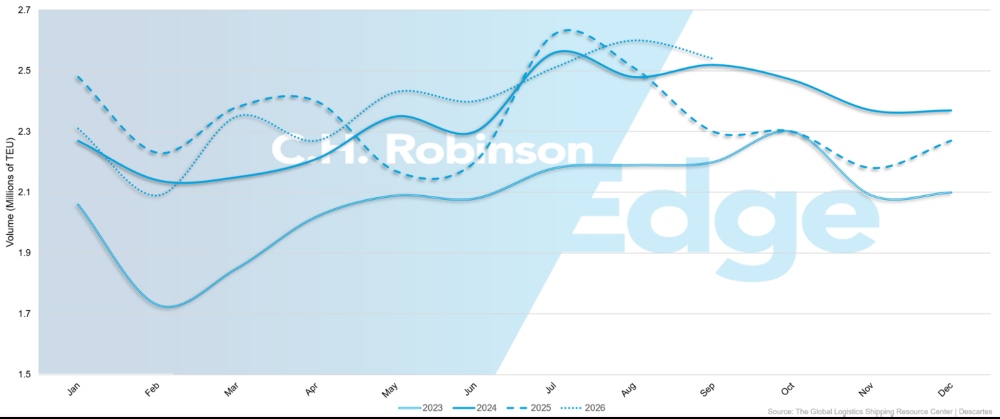
The National Retail Federation's Global Port Tracker forecasts approximately 2 million TEUs in November, down 1% year over year (y/y). Although its methodology differs from Descartes Datamyne, the forecast points to a seasonal slowdown. Whether this leads to lower rates or improved booking availability will depend on how vessel capacity is deployed across individual services.
Potential labor disruption this month at the ports of Los Angeles and Long Beach is another potential factor. Should a strike occur, watch for our customer advisories.
New vessels are expanding the global container fleet, but congestion continues absorbing available capacity. As estimated in the October Edge Report, 12% of global container capacity is eaten up by stresses on the ocean network, particularly across East Asia, North Europe, and the Indian Subcontinent.
Delayed port calls, vessel bunching, and transshipment interruptions reduce the number of reliable departures available to shippers. Extended voyage cycles also delay the return of vessels and containers to origin markets.
As carriers adjust schedules and vessel deployment to demand and operating conditions, additional fleet capacity may not immediately translate into improved booking availability or lower rates.
For November, moderating demand may improve booking, but it will vary by service and gateway. On the Trans-Pacific, Asia port backlogs and disrupted vessel schedules in the wake of consecutive typhoons have been easing but continue influencing booking availability.
On Asia–Europe lanes, moderate demand coincides with improving vessel circulation and additional services returning to shorter routes through the Suez Canal instead of transiting around Africa’s Cape of Good Hope.
Shippers should distinguish between additional vessel space and the reliability of departures, particularly where transshipment or inland connections remain vulnerable to delays.
Middle East security risks intensify as shipping networks adapt
Security conditions across the Middle East have deteriorated, adding uncertainty to regional shipping even as more container services return through the Red Sea and Suez Canal.
Attacks on commercial shipping in and around the Strait of Hormuz intensified during October, increasing risks for vessels operating in the Persian Gulf. Additional strikes on regional transportation and energy infrastructure have heightened concerns about service continuity and operating costs.
Although commercial traffic continues through the Strait of Hormuz, routine container services to several Persian Gulf destinations remain severely limited. Carriers are using alternative gateways and combinations of ocean and inland transportation to serve affected destinations.
Options include Jeddah and King Abdullah Port on Saudi Arabia’s Red Sea coast, as well as Khor Fakkan and Fujairah in the United Arab Emirates, outside the Strait of Hormuz. Available routings depend on the carrier, destination, and onward transportation arrangements.
These alternatives face their own operating constraints. Jeddah and King Abdullah Port are experiencing terminal and inland congestion, while a rise in redirected cargo is adding pressure at Khor Fakkan and Fujairah. Additional handling, limited onward connections, and inland transportation requirements can extend delivery times and increase costs.
Selected Middle East services are adding war-risk, emergency, and port congestion surcharges in response to heightened security issues, longer routes, higher fuel costs, and added inland handling. Further changes to these charges remain possible during November as carriers respond to operating conditions.
Meanwhile, more container services continue returning to the Suez Canal. As of late October, Linerlytica reported the number of container ships diverted around the Cape of Good Hope had fallen to approximately 180, compared with an average of 350 over the previous two years.
Of the service loops tracked, 30 of 52 westbound and 32 of 57 eastbound loops had resumed Suez routing, with further restorations scheduled for November.
Shorter voyages can improve vessel and container circulation, releasing capacity without adding ships to the fleet. However, the transition remains uneven across carrier networks. Revised vessel rotations may also temporarily concentrate arrivals at North European gateways as shorter Suez services overlap with vessels completing longer Cape voyages.
Security risks remain a constraint on further network recovery. Threats along the Red Sea and Bab el Mandeb corridor could slow additional Suez restorations or prompt carriers to reconsider routes already reinstated.
For November, shippers moving cargo into the Persian Gulf should confirm carrier acceptance, the discharge port, onward transportation arrangements, and applicable surcharges before committing to delivery schedules.
Asia–Europe shippers should continue checking whether their service uses the Suez or Cape of Good Hope and whether revised vessel rotations affect arrival or connection reliability.
Trans-Pacific rates remain firm as schedule recovery progresses
Trans-Pacific ocean freight enters November with moderating U.S. import demand, although vessel availability and rate conditions continue varying by service and destination.
Congestion at Shanghai and Ningbo has eased following Golden Week in China, although residual cargo backlogs and delayed vessel rotations continue affecting schedule reliability. Disruptions have also extended into Southeast Asian transshipment hubs, including Singapore, where delayed arrivals and revised port rotations can affect onward connections.
Typhoon Champi disrupted vessel movements and port operations around Shanghai and Ningbo in late October, adding delays to services still recovering from Golden Week. Missed port windows and revised departures may continue affecting November sailings as carriers clear the resulting backlog.
Lower seasonal import volumes should gradually improve booking flexibility, particularly where vessel schedules have stabilized. However, the relationship between demand and available capacity will also depend on planned sailings, service adjustments, and vessel deployment between U.S. gateways.
Continued rollovers or limited departure choices on individual services may contribute to firmer spot rates even as the broader market eases. Conversely, more consistent sailing schedules and lower vessel utilization could create rate relief as November progresses.
U.S. East Coast services may continue carrying a premium over West Coast options where longer vessel rotations and service-specific capacity constraints limit available departures.
Panama Canal operating conditions have improved, providing greater routing flexibility for services to the U.S. East and Gulf Coasts. The canal increased daily transit slots to 33 effective October 15, while the maximum authorized Neopanamax draft had already been raised to 49 feet in late September.
These improvements help with planning, although transit reservations remain important. As the dry season approaches, water levels could also influence future operating conditions.
Shippers should compare available sailings, expected rollover exposure, and canal transit arrangements when selecting November departures. More competitive rates may become available as demand moderates, but schedules and end-to-end transit reliability should remain part of the comparison.
Asia–Europe rates stabilize as effective capacity improves
Asia–Europe ocean freight enters November with moderate demand, relatively stable spot rates, and a changing supply outlook as additional effective capacity becomes available.
The return of shorter Suez Canal routings is improving vessel and equipment circulation on selected services. Combined with new vessel deliveries, this could increase capacity at a time when cargo demand is not expanding at the same pace. If those conditions persist, rates into North Europe and the Mediterranean could drop.
As carriers adjust vessel deployment and sailing frequency, the additional capacity becoming available may increase pricing competition on selected services. General rate increases and fuel adjustments could still affect November pricing, but their impact will depend on individual services and prevailing market conditions.
Port congestion remains a counterweight to improving vessel supply. Rotterdam, Antwerp-Bruges, and Hamburg continue facing operational pressures, while overlapping arrivals from Suez and Cape routings could temporarily strain terminal handling and inland connections. These conditions may affect transit reliability even where vessel space is readily available.
What could change the November outlook
November's ocean outlook will depend on whether moderating demand and improving vessel circulation produce more consistent departures. On the Trans-Pacific, fewer rollovers and more reliable sailings would indicate that post-Golden Week and weather-related disruption is clearing.
On Asia–Europe, further Suez restorations and steadier gateway operations could increase available capacity and soften rates.
Renewed Middle East security incidents, further port disruption, or concentrated vessel arrivals could interrupt that recovery. Shippers should monitor service-level performance rather than assume that fleet growth or lower demand will produce immediate improvements across every route.
Indicators to watch
- Trans-Pacific vessel utilization, rollovers, and blank sailings
- A potential strike at the ports of Los Angeles and Long Beach
- Spot-rate differences between U.S. East Coast and West Coast services
- Suez service restorations and revised vessel rotations
- Panama Canal reservation availability and water levels
- Middle East security developments and changes to applicable surcharges
- Berthing delays and transshipment connections at North European gateways
Notable shifts this month
Trans-Atlantic westbound space improves, but direct service options remain uneven
Consistent European export demand and improving vessel capacity means conditions for Trans-Atlantic westbound ocean freight are relatively balanced entering November.
Space has improved compared with peak summer conditions, particularly from North Europe to the U.S. East Coast. However, services to the U.S. Gulf and West Coast are more constrained, reflecting differences in vessel deployment and available departures.
West Mediterranean conditions remain comparatively stable, although blank sailings and schedule changes may limit booking flexibility on select services. From Türkiye and the east Mediterranean, the distinction between direct and transshipping options remains important.
Transshipment can expand routing choices but introduces additional connection points and potential variability in delivery timing.
Rates are expected to remain broadly stable through November. Shippers with cargo moving from Türkiye or the Mediterranean should compare direct service schedules with transshipment alternatives, particularly where limited departures or additional connections could affect delivery commitments.
Canadian West Coast vessel arrivals continue affecting inland rail flow
The ports of Vancouver and Prince Rupert continue to experience periods of congestion as delayed vessels arrive from Asia. Strong imports and bunched vessel arrivals can increase demand for railcars and outbound connections, extending the time between container discharge and inland departure.
Localized railcar shortages may persist even when the broader Canadian network is operating normally.
Winter weather introduces another risk as severe cold, snow, and ice can reduce train lengths, restrict operating speeds, and extend transit times across affected lanes.
For cargo moving through western Canada, rail availability and transit time should be incorporated into the delivery schedule rather than relying solely on the vessel’s estimated arrival date.
Eastern Canadian gateways remain comparatively stable. Montreal has greater labor certainty following a collective agreement that will be in place through 2028, while Halifax and Toronto continue operating under generally normal conditions.
Chilean cherry exports tighten refrigerated equipment and vessel availability
Chile’s cherry export season is increasing demand for refrigerated containers and vessel space along the West Coast of South America in November. As seasonal volumes build, container positioning and vessel allocations are becoming more closely tied to refrigerated export requirements.
Vessel repairs, weather-related schedule adjustments, and blank sailings are tightening capacity on some services. These factors can reduce available departure options for both refrigerated and general cargo, although the impact will vary by commodity and destination.
Carriers have announced peak-season, general-rate, and fuel-related pricing adjustments. The combined effect of seasonal demand and service disruption could also increase booking lead times and rollovers, particularly for North America-bound cargo.
For November, container availability may become as important as vessel space for refrigerated exporters. General-cargo shippers should also evaluate departure options where concentrated seasonal demand is affecting vessel utilization and booking flexibility.
Oceania agricultural exports increase pressure on equipment availability
Australia and New Zealand enter November with strong agricultural and refrigerated export demand, taking up vessel space across meat, dairy, fruit, and grain trades.
Conditions vary across Australia’s agricultural regions. Western Victoria is forecasting a stronger grain harvest than in 2025, while drought is reducing production in parts of the Riverina region. These differences may concentrate shipping demand and container needs at particular origins rather than creating uniform demand across the country.
Twenty-foot container availability remains constrained in several Australian export markets, particularly Melbourne. Strong agricultural and other commodity demand is increasing the importance of container positioning, equipment-release timing, and vessel allocation when confirming export bookings.
Import capacity from North Asia and Southeast Asia remains generally sufficient, although congestion at some Chinese ports and container shortages at some Southeast Asian origins can affect individual departures.
Selected Europe–Oceania services returning through the Suez Canal instead of being diverted around Africa may offer shorter transit times and improved container circulation, although routing and schedule reliability remain service-specific.
Requirements for brown marmorated stink bug season remain in effect for designated cargo entering Australia and New Zealand. Treatment, certification, and documentation requirements can affect shipment readiness and destination clearance even when ocean capacity is available.
Mexico exports remain sensitive to port congestion and inland execution
Mexico's ocean export market remains relatively balanced in terms of demand vs. capacity, but congestion and inland transportation continue influencing service reliability and total shipment costs.
The Port of Manzanillo remains a primary pressure point, with terminal access limitations, truck appointment requirements, and schedule changes increasing the possibility of missed cutoffs and container rollovers. Delays can also extend equipment cycle times and generate additional storage, demurrage, or redelivery costs.
Lázaro Cárdenas provides an alternative for selected Pacific export shipments, while Altamira and Ensenada continue operating under comparatively stable conditions. The suitability of an alternative gateway will depend on inland origin, rail and truck connectivity, container availability, and ocean services.
While base ocean rates have remained relatively stable on many services, congestion-related expenses can increase total transportation costs. Shippers evaluating alternative gateways should compare inland transportation, terminal access, container availability, and vessel schedules alongside the ocean rate.
Planning ahead for November ocean freight shipping
As seasonal demand moderates and global vessel networks adjust, shippers should evaluate how changes in capacity, routing, and container availability affect individual shipments. Improving overall market conditions may not translate into consistent service across every trade lane.
1. Where is improved vessel availability creating reliable booking options?
For Trans-Pacific shipments, compare current vessel schedules, port rotations, and rollover activity against October conditions. More consistent departures and lower vessel utilization may create opportunities to reassess service options as November progresses, particularly where delivery schedules allow flexibility.
But for U.S. East Coast shipments routed through the Panama Canal, confirm transit reservations and service schedules as the dry season approaches.
2. How are Middle East security conditions affecting available routes?
For Persian Gulf shipments, confirm carrier acceptance, discharge gateway, transshipment arrangements, inland transportation, and applicable surcharges. For Asia–Europe and Europe–Oceania cargo, verify whether the selected service operates through the Suez Canal or around the Cape of Good Hope, and compare actual transit times and connection reliability.
3. Could equipment or handling requirements limit available shipping options?
For refrigerated exports from Chile and Oceania, confirm container availability alongside vessel space. Australian exporters requiring 20-foot containers should account for positioning needs, while shipments subject to stink bug regulations may need additional treatment or documentation before departure.
4. Where could gateway or inland conditions affect delivery reliability?
For U.S West Coast imports, watch the strike deadline for the labor union negotiating its contract at the ports of Los Angeles and Long Beach. For Canadian West Coast imports, incorporate terminal dwell time and railcar availability into expected delivery dates.
For Mexico exports, compare terminal access, inland transportation costs, container availability, and cutoff dates when selecting ports. For Trans-Atlantic westbound freight, compare direct service availability against transshipment alternatives, particularly Türkiye and shipments destined for the U.S. Gulf or West Coast.

 Insights acionáveis sobre frete